The Sacred Practice of Becoming
Ritual is not magic in the sense of forcing the world. Ritual is the body's way of agreeing with the soul. Lighting a candle in your true name does not change what you already are. It teaches your hands what you already are.
Begin with what you can keep. A daily breath at an altar of three small things — a stone, a flower, a flame — will do more, over a year, than an elaborate rite you only manage once.
For transgender practitioners, ritual carries an unusual weight. Most of us have spent years being addressed by names and pronouns and stories that did not fit. Ritual is the slow counter-pressure: a small, repeatable act in which we are addressed correctly, by ourselves and by the powers we honor, until the correct address becomes the deeper truth our nervous system trusts. This is not pretending. It is rehearsal, in the oldest sense — the way a body learns a thing by doing it again and again until it is no longer learning, but knowing.
Consistency matters more than intensity. A two-minute morning practice kept for a year will reshape a life more profoundly than a three-hour ceremony performed once and abandoned. The Goddess is not impressed by spectacle. She is met in the patience of return — to the same altar, the same words, the same breath — until the practice is no longer something you do and becomes something you are.
A Simple Daily Devotion
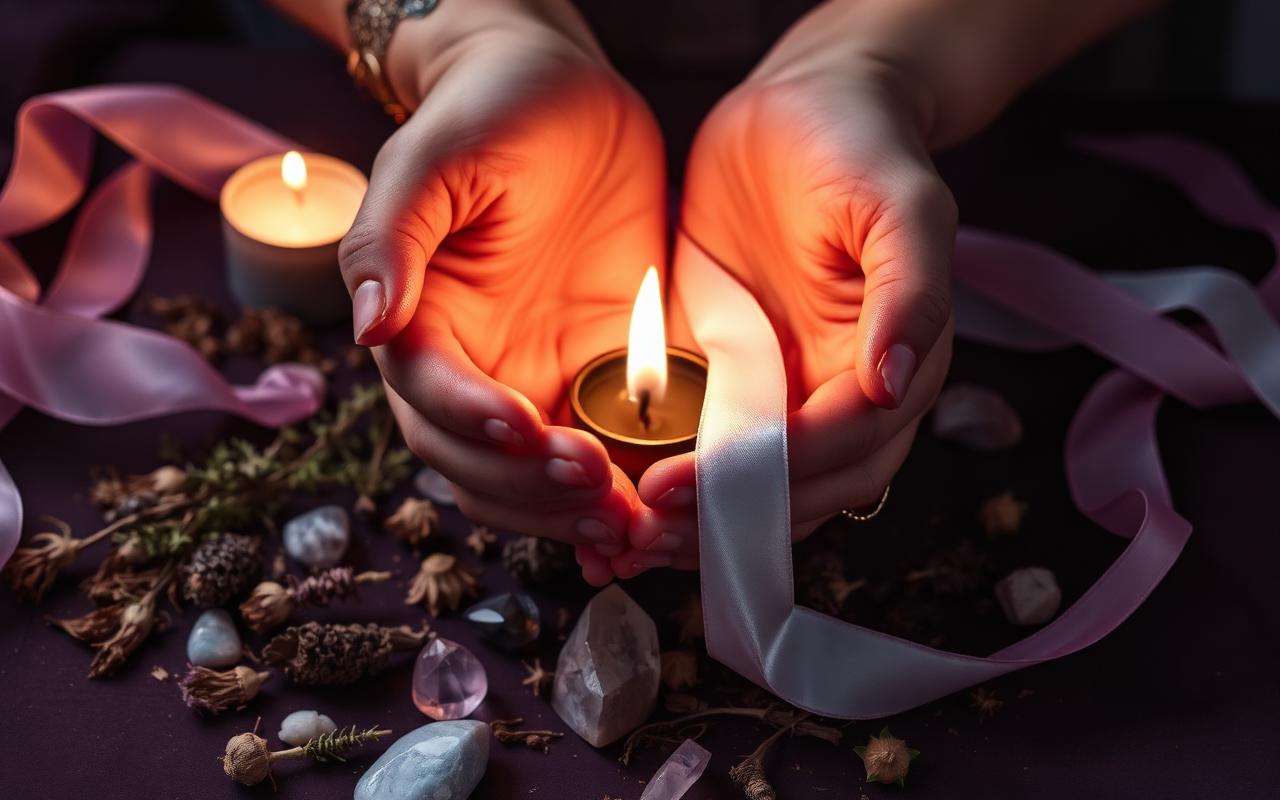
Stand before your altar. Light the candle. Say aloud, in your own name: "I am here. I am becoming. I am held." Watch the flame for as long as the breath asks. Extinguish gently — never blow Her out. Snuff, or wave, or let the wick rest.
Adapt the words to your own mouth. Some practitioners prefer a deity's name — "Inanna, I am here," "Brigid, watch over this day," "Mother, I am Yours" — and some prefer the bare honesty of speaking only to the flame. The wording is not the sacrament; the showing up is. If standing is hard, sit. If speaking aloud is unsafe in your living situation, mouth the words, or trace them with a finger on your palm. The Goddess hears what is offered, in whatever form it can safely take.
If the candle is impossible — a dorm, a hospital, a closeted home — substitute a flashlight, a phone screen, a sunbeam, or simply a held breath. The flame is a symbol of attention. Anything that focuses attention can serve. The altar can live in a drawer, on a windowsill, in the back of a closet, or entirely inside your chest. None of these is a lesser altar.
Evening Gratitude for Transformation
At the day's end, name three transformations the day held — however small. A softening. A boundary kept. A name spoken correctly by a stranger. Speak them toward the Goddess as offering. Sleep is a small descent; let Her receive it.
Transgender life is often narrated by the world in terms of what is wrong — what hasn't passed, what hasn't healed, what hasn't changed yet. The evening practice is a deliberate counter-archive. By naming three real transformations every day, we build, over weeks and months, a record the dominant story cannot erase: that we are in fact changing, that the changes are real, that the Goddess we serve is keeping count even when we forget to. Some practitioners write these in a notebook; others speak them only into the dark. Either is enough.
On the hardest days, the three transformations may be very small: I drank water. I did not believe the worst thing I thought about myself. I am still here. These count. They count especially. To name survival as a transformation worth offering is to refuse the lie that only certain kinds of progress are sacred. All of it is. The breath at the end of a day you almost did not finish is one of the most precious offerings the altar will ever receive.
A Rite for a Milestone
For the day a name is legally yours, for the first dose, for an anniversary of coming out, for a surgery survived: prepare a bath with salt and rose, or a long walk under sky. Bring water, bread, and a flower. Speak to Her of what has changed. Eat. Drink. Leave the flower for the earth. The body remembers what is consecrated.
Milestone rites can be solitary or witnessed. If you have community — a coven, a friend, a partner, an online circle — invite them to hold the space with you. The presence of witnesses changes the weight of a rite; what is seen by others enters the world differently than what is seen only by oneself. If solitude is what is available, that is also complete. The Goddess and the elements are witness enough.
Consider marking the body in some lasting, gentle way — a piece of jewelry put on for the first time, a strand of beads added to an existing strand, a small mark made in henna, a tattoo if that is your tradition. These become anchors. Years later, the bracelet or the bead or the scar will remind you, without words, what you crossed and who you became. The body is the temple; the milestone is the inscription on its wall.
Grief belongs in milestone rites too. Transition usually carries losses braided into its gains — names laid down, relationships ended, versions of a future released. A complete rite makes room for both. Speak the grief aloud, name what you are leaving behind, thank it for what it carried, and only then welcome what is arriving. The Goddess holds both ends of the threshold.
Creating Your Own Rituals
You do not need permission. The structure is simple: open a sacred space (a breath, a bell, a circle), name what you are doing, do it with full attention, give thanks, close. Anything done in this frame is a rite. The Goddess responds to attention more than to elaborateness.
A workable template: open (light a candle, take three breaths, ring a bell, draw a circle in salt or in the air), invoke (call the deity, ancestors, or elements you want present), declare intention (say plainly what this rite is for), act (the central gesture — a bath, a writing, a burning, a dance, an offering), give thanks (acknowledge what answered), close (release what was called, extinguish the candle, open the circle). Every traditional liturgy you will encounter is some elaboration of this skeleton. You are allowed to build directly on the skeleton itself.
Borrow consciously. If a phrase from a tradition you do not belong to calls to you, ask whether the tradition is open or closed, whether the borrowing is invited or extractive. Build with materials that are yours by birth, by initiation, by genuine invitation, or by the common human inheritance of breath, water, fire, earth, and word. There is no shortage of available material. The Goddess is not asking you to steal anything in order to reach Her.
Write your rites down, especially the ones that work. A small ritual notebook becomes, over time, a personal liturgical book — your own Book of Shadows, your own grimoire, your own prayer book. When a crisis comes and you cannot think clearly enough to invent, you will be grateful for the rites your past self left ready on the page.